

Why RAM Prices Will Continue To Rise?
If you have tried to buy a new smartphone, upgrade your laptop, or build a gaming PC recently, you have likely noticed a painful trend: the ram prices is skyrocketing. Tech enthusiasts are calling it “RAMageddon.” In early 2026, memory costs surged so violently that they forced the entire consumer electronics industry to rewrite its price tags. Apple quietly raised the prices of its MacBooks by up to $500 for higher memory configurations, Microsoft adjusted Xbox pricing, and the cost of buying standard PC RAM off the shelf jumped by hundreds of dollars compared to a year ago.
This isn’t just corporate greed or standard inflation. The global technology supply chain is currently experiencing a historic bottleneck. To understand why your next laptop is so expensive, we have to look past the Apple Store and journey into the hyper-clean, multi-billion-dollar factories where silicon is transformed into data.
At the center of it all is a massive collision: the insatiable hunger of Artificial Intelligence is devouring the finite supply of the most complex manufacturing process in human history.
1. How Chips Are Made: Printing a Microscopic City
To understand why the world cannot simply “make more RAM,” we first need to understand how computer memory is actually manufactured. It is not assembled on a conveyor belt with screws and glue; it is literally printed on an atomic level.
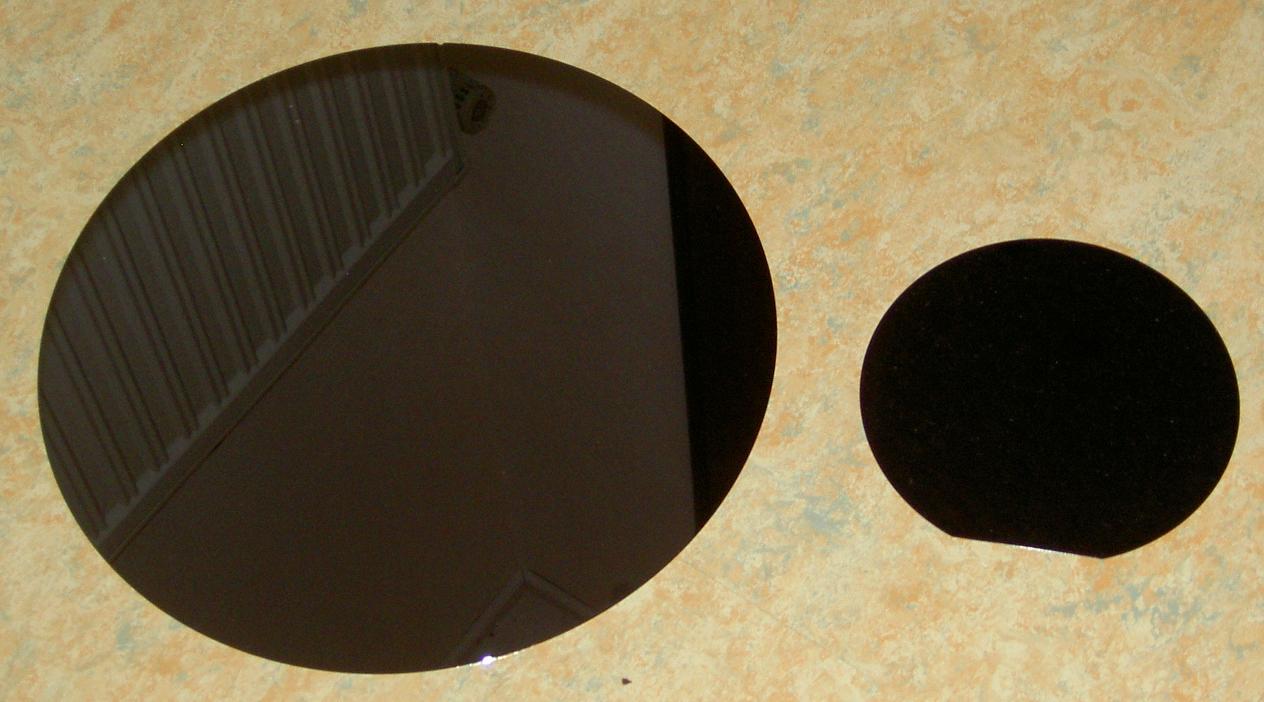
Everything begins with a silicon wafer. Imagine a perfectly flat, mirror-finish silver pizza that is exactly 12 inches (300 millimeters) across. This wafer is a slice of an ultra-pure silicon crystal, and it serves as the blank canvas for chipmakers.
To turn this blank wafer into functional computer memory, manufacturers use a process called photolithography. In simple terms, they project light through a blueprint (a mask) and shrink that projection down so small that it prints microscopic circuits onto the silicon. Because modern chips have billions of microscopic transistors, the light used to print them must have an incredibly short wavelength.
The ASML Bottleneck
This brings us to the single biggest chokepoint in global technology: a Dutch company named ASML.
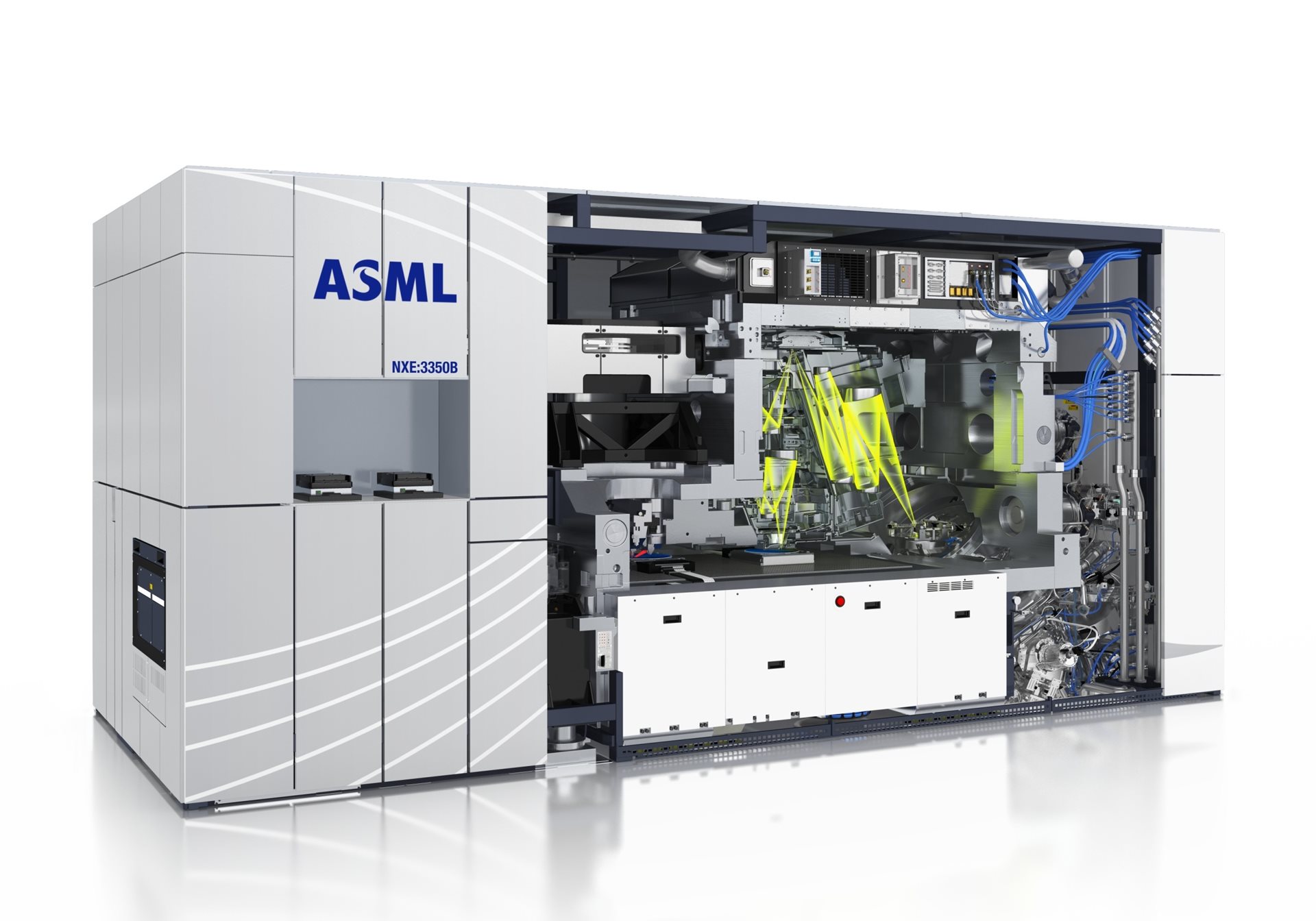
ASML is the only company on Earth capable of building Extreme Ultraviolet (EUV) lithography machines. These machines are the “printers” required to make advanced memory chips. An EUV machine is a marvel of physics that borders on science fiction. Inside the machine, a laser fires at microscopic droplets of molten tin 50,000 times per second. This vaporizes the tin, creating a brief flash of extreme ultraviolet light. That light is bounced off perfectly flawless mirrors, manipulated, and fired onto the silicon wafer to etch the circuitry.
Each one of these ASML machines weighs around 180 tons, takes months to assemble, and costs roughly $350 million. Because building these machines is so difficult, ASML can only produce a limited number of them per year. In 2025, they shipped 327 lithography systems globally across all categories, and only a fraction of those were the cutting-edge EUV systems.
The $20 Billion Environment
You cannot put a $350 million EUV printer in a normal warehouse. The circuits it draws are so microscopic that a single speck of dust, a minor temperature shift, or the vibration from a passing truck will ruin the silicon.
Because of this, memory companies must build “gigafabs” (fabrication plants) to house these machines. These buildings cost upward of $20 billion. They feature cleanrooms that are thousands of times cleaner than a hospital operating room, built on top of massive concrete shock absorbers to prevent vibrations. It takes roughly three to five years just to build the building before a single chip is made.
The “Big Three” Oligopoly
Given the $20 billion price tag of a factory and the requirement to buy $350 million printers from a single Dutch company, the barrier to entry in this industry is insurmountable for new players. You cannot start a memory company in a garage.
As a result, the global DRAM (Dynamic Random Access Memory) market is effectively controlled by just three massive corporations. As of early 2026, their market share looks like this:
- Samsung (South Korea): Roughly 38% of the global market. The traditional volume king, producing massive amounts of memory for phones and PCs.
- SK Hynix (South Korea): Roughly 29% of the overall market, but they dominate the lucrative AI memory space with nearly 60% of the market share.
- Micron (United States): Roughly 22% of the market, serving as America’s sole advanced memory manufacturer.
Why doesn’t Apple or Google just build their own fabs? Because beyond the money, Samsung, SK Hynix, and Micron hold four decades of specialized chemical and material patents, alongside a monopoly on the engineers who know how to run these machines. The Big Three are the only game in town.
2. The Types of Memory: Wafers, Dies, and HBM
Now that we know who makes the memory and the machines they use, we need to look at what they are actually building, because not all RAM is created equal.
When the ASML machine finishes printing circuits onto the 12-inch silicon wafer, that circular wafer is sliced into a grid of tiny rectangular squares. Each one of those functional little squares is called a die (plural: dies). These dies are the raw brains of the memory. What happens to the die next determines whether it goes into your laptop or into an AI data center.
Standard Consumer Memory (DDR5)
If you open up a modern laptop or desktop PC, you will find DDR5 RAM. This memory is built using a horizontal structure. A manufacturer takes a few of those raw memory dies and solders them flat onto a green rectangular circuit board (a DIMM stick). This stick plugs into your motherboard. Data has to travel across the motherboard’s copper wires to reach the processor. For consumer electronics, this is fast enough.
AI Data Center Memory (HBM – High Bandwidth Memory)
Artificial Intelligence models like the ones that generate text, write code, or create images cannot wait for data to travel across a motherboard. They need an oceanic amount of data instantly.
To solve this, the industry created High Bandwidth Memory (HBM). Instead of laying the memory dies out flat, HBM physically stacks them vertically, like a 12-story skyscraper. The manufacturer drills microscopic holes directly through the silicon dies and runs copper wires down through them. This massive, 3D-stacked tower of memory is then placed right next to the AI processor (GPU), just millimeters away. This allows an AI chip to ingest data at blistering speeds while using very little electricity.
The Machine Capacity Limit
Here is where the shortage begins. Building an HBM skyscraper is incredibly difficult.
A silicon wafer cannot be printed all at once. Because the circuitry is layered, the wafer has to go into the ASML EUV machine, get a layer printed, come out to be chemically washed and baked, and then go back into the machine for the next layer. Advanced AI memory requires up to 20 or 30 separate passes through the EUV machine.
If an EUV machine runs 24 hours a day at maximum speed, processing about 220 wafers an hour, it might only complete roughly 264 completely finished, multi-layered wafers per day.
If a finished wafer yields roughly 300 good, working dies, one $350 million machine running perfectly all day generates about 79,200 raw memory dies. That sounds like a large number until you realize how many of those dies are swallowed by artificial intelligence.
3. The Math: Why The Dots Connect to a Shortage
To truly understand why laptop prices are up, we have to look at the brutal mathematics of supply and demand in 2026. The world’s memory manufacturers are trapped in a zero-sum game, and the consumer is losing.
The Demand Side: The AI Black Hole
Let’s look at a single, modern hyperscale AI data center being built by tech giants like Microsoft, Meta, or Google.
- A standard high-end AI data center houses roughly 100,000 AI GPUs.
- Every single one of those AI GPUs requires six towers of HBM memory.
- Each HBM tower is made of 12 stacked memory dies.
- Therefore, one AI GPU requires 72 individual memory dies.
If a data center buys 100,000 GPUs, that single facility instantly consumes 7.2 million memory dies.
In 2025 and 2026, tech giants are purchasing millions of these GPUs. Industry projections suggest NVIDIA alone could ship upwards of 5 million high-end AI GPUs. To feed those 5 million AI chips, the Big Three memory makers must supply roughly 360 million ultra-complex HBM dies.
The Supply Side: The Breaking Point
Now, let’s look at what the ASML machines can physically produce.
There are only a few hundred EUV machines operating on the entire planet, and many of them are busy making processors for Apple iPhones or PC CPUs. Only about 110 to 120 of these machines worldwide are dedicated to printing memory.
If we take our earlier math where one machine outputs 79,200 dies a day and multiply it across the global fleet, the entire planet can only produce about 8 to 9 million memory dies per day under absolutely perfect conditions. That is roughly 3.1 billion memory dies per year.
The Collision
We have a theoretical maximum production of 3.1 billion dies a year. The AI industry demands about 360 million of the most difficult, time-consuming dies to make.
That leaves roughly 2.7 billion dies for the rest of the world. But consider the consumer market:
- The world buys roughly 1.2 billion smartphones a year. If each phone uses 4 memory dies, that is 4.8 billion dies.
- The world buys roughly 250 million PCs and laptops a year. If each uses 8 memory dies, that is 2 billion dies.
The math simply does not work. Standard consumer tech demands nearly 7 billion dies, but the factories can only squeeze out a fraction of that. Because tech giants are willing to pay massive premiums for HBM AI memory, Samsung, SK Hynix, and Micron are aggressively dedicating their limited wafer capacity to the AI data centers.
Every time a wafer is used to build a 12-story HBM tower for Meta’s new data center, that is one less wafer available to make the standard DDR5 memory for a MacBook or an Xbox. The factories are physically maxed out. As a result, the price of whatever standard consumer memory is produced shoots through the roof.
4. Geopolitics and the DDR4 Phase-Out
If the factories in the West and South Korea are full, standard economic theory suggests that competitors in other countries like China should spin up their own factories, flood the market with cheap memory, and bring prices down.
The Geopolitical Freeze
In the semiconductor world, this is impossible due to geopolitics. Because advanced AI chips are viewed as critical for national security and military supremacy, the United States has enacted strict export controls. The US successfully pressured the Dutch government (where ASML is based) to ban ASML from selling their EUV machines to China.
Without ASML’s EUV printers, Chinese memory manufacturers like CXMT are trapped. They are attempting to build their own domestic lithography machines, but current reports indicate these homemade machines are slow, inefficient, and ruin more than half the silicon they attempt to print. Because China is locked out of the advanced tooling market, they cannot step in to rescue the global supply chain. The world is entirely reliant on the ASML machines already operating in Taiwan, South Korea, and the US.
The Artificial Scarcity of DDR4
Adding insult to injury for the consumer is the transition between memory generations. The tech industry is currently phasing out older DDR4 memory in favor of the newer, faster DDR5 standard.
Because Samsung, SK Hynix, and Micron have limited factory space, they are actively shutting down their older DDR4 production lines so they can retool those lines for DDR5 and HBM. However, there are still hundreds of millions of people using older laptops, corporate servers, and home PCs that require DDR4 memory to upgrade or repair their systems.
This has created a massive, artificial scarcity in legacy tech. As the “Big Three” stop making DDR4 to chase AI profits, the supply of older memory has evaporated. This is why even a basic, older RAM stick that cost $40 three years ago now costs significantly more. Consumers are being squeezed at both ends: cutting-edge DDR5 is expensive because it competes with AI for wafer space, and older DDR4 is expensive because they simply stopped making enough of it.
5. Conclusion: When Will It End?
The “RAMageddon” of 2026 is a perfect storm. It is the result of a sudden, explosive demand for Artificial Intelligence colliding with the hardest physical limits of atomic engineering.
We are not facing a shortage of money or desire; we are facing a shortage of physics and time. There is only one company in the world that makes the $350 million printer required to make advanced memory. They can only build a few dozen a year. The three companies that buy those printers require years to construct the $20 billion cleanrooms to house them. And once the machines are running, the wafers take weeks of microscopic layering to complete.
Until new gigafabs finish construction and come online which industry analysts predict won’t happen meaningfully until late 2027 or 2028 the global memory supply will remain fundamentally broken.
The tech giants building AI data centers will continue to outbid consumer electronics companies for the limited supply of silicon. Apple, Microsoft, Dell, and Sony have no choice but to pass those skyrocketing component costs down to the buyer. So, if you are wondering why your next phone or computer is so painfully expensive, you now know the culprit: you are directly competing with the multi-trillion-dollar race to build Artificial Intelligence, and the world simply does not have enough printers to satisfy both of you.




Top rated products
-
 Probability and Statistics for Machine Learning and Data Science
Original price was: ₹599.00.₹349.00Current price is: ₹349.00.
Probability and Statistics for Machine Learning and Data Science
Original price was: ₹599.00.₹349.00Current price is: ₹349.00.
-
 SVM Notes: Optimization & Implementation
Original price was: ₹399.00.₹249.00Current price is: ₹249.00.
SVM Notes: Optimization & Implementation
Original price was: ₹399.00.₹249.00Current price is: ₹249.00.
-
 Spidy Mail Hunter: Powerful And Intelligent Website & PDF Email Extractor Software (Windows App)
Original price was: ₹9,999.00.₹599.00Current price is: ₹599.00.
Spidy Mail Hunter: Powerful And Intelligent Website & PDF Email Extractor Software (Windows App)
Original price was: ₹9,999.00.₹599.00Current price is: ₹599.00.
-
 Linear Algebra For Machine Learning And Data Science
Original price was: ₹699.00.₹449.00Current price is: ₹449.00.
Linear Algebra For Machine Learning And Data Science
Original price was: ₹699.00.₹449.00Current price is: ₹449.00.
-
 Javascript Document Object Model Notes And Codes
₹499.00
Javascript Document Object Model Notes And Codes
₹499.00
Recent Posts
Neuraldemy

Neuraldemy
Software Development
Neuraldemy helps you learn ML, AI, Web Dev and data science from scratch. Addtionally, we also provide web development and hosting services for businesses, and individuals